EOS® Meeting Agendas Guide
Stay on track in your meetings with EOS® recommended agendas that you can customise to fit your business needs.
Templates
All new user accounts come with a set of agenda templates that follow the recommended EOS® meeting structures for different meetings your team might need:
- Annual Planning (day 1) - EOS®
- Annual Planning (day 2) - EOS®
- Focus Day - EOS®
- Quarterly pulsing™ agenda - EOS®
- Vision building session - EOS®
- Weekly L10 meeting - EOS®
You can use these templates as they are, or edit the timings and reorder or add new sections to customise them to meet the needs of your teams. You can also create custom templates of your own.

Creating a new agenda
To create a new agenda, click the Add agenda button. A popup will appear where you can name the agenda, add an optional description, select the team it applies to, assign the meeting facilitator and scribe, and choose whether the meeting is a stand-alone meeting or a recurring one.
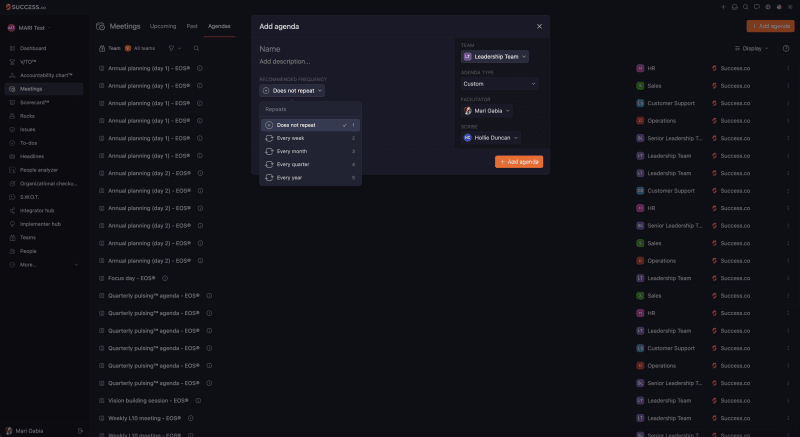
When you click the Add agenda button your new agenda will be added to agendas list as a custom agenda.

Updating the Agenda
Updating Existing Agenda
Our existing agendas follow the standard EOS® meeting format recommended by EOS. We strongly recommend using this structure, as it is designed to support effective and productive meetings.
That said, you are welcome to customize the agenda to fit your team’s needs. If you would like to make changes, simply select the Edit Agenda button to update it.

Updating a Custom Agenda
When you open a newly created custom agenda, you will see that only the Conclude section is available by default. To add more meeting sections, click the Add section button and customize the agenda as needed.

Meeting sections
Each L10 meeting follows a structured agenda made up of multiple sections. These sections help keep the meeting organized, ensure all important topics are covered, and maintain focus on solving issues and driving results. You can customize these sections to fit your team’s workflow and priorities.
Existing sections you can choose from:
- Segue
- Scorecard™
- Rocks
- To-dos
- Issues (short-term)
- Issues (long-term)
- V/TO™ - Vision
- V/TO™ - Traction
- Accountability Chart™
- Organizational Checkup™
- S.W.O.T Analysis
- Custom

Custom sections
Custom sections allow you to add a custom name and description that will display in the middle of the screen during that section of the meeting. You can also add a link to external resources that will be displayed as an iframe within the meeting section.
To edit your custom section click the cog icon.

For external urls please ensure your url starts with https:// for security purposes.

You will be able to see a preview of your links content by clicking the preview button. If everything looks ok click the Looks good button.
Some websites do not allow their content to be shown in iframes, in which case you will see an error. If it does not show your preview you can click the it does not work button and it will clear the url box for you.

This is ideal for things like Google Sheets and Docs where you keep additional information and you will be able to edit things directly in the iframe during your meeting.

Reorder sections
To change the order of a section, you can drag it using the 6-dot icon located just before the section name.

Rename a section
You can rename a meeting section by updating the section name field.
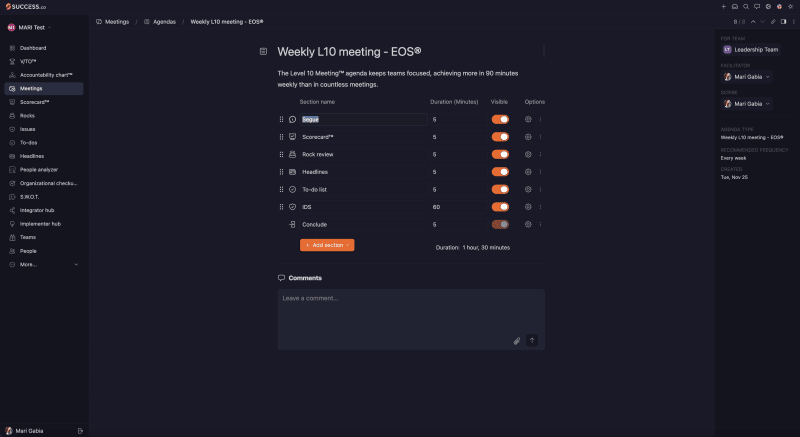
Update section time
When you attempt to edit the time or duration of an existing agenda section, a flag will appear to notify you.
Custom formats can be helpful, but for the best results, we recommend using the standard EOS® meeting format, as it is the EOS®-recommended structure.
- Reset to recommended format: If you wish to disregard your changes and return to the recommended structure, click the Reset to recommended format button.
- Update section time: To proceed with editing, use the up and down arrows or click in the box and enter the duration using your keyboard.
The time is measured in whole minutes and will automatically be added to the total meeting time displayed at the bottom of the agenda.

Toggle section visibility
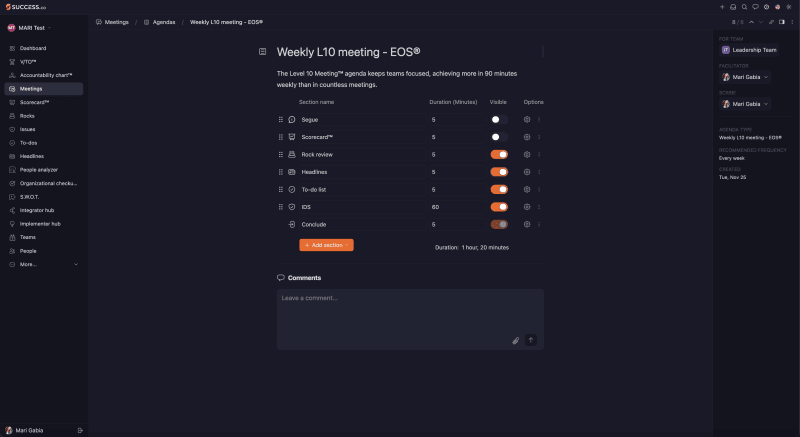
You can use the visible toggle to choose which sections you want to show or not show in a meeting.
If the toggle is to the right and the toggle background is orange then the section will be visible. If the toggle is to the left and the toggle background is blue it will not be shown in the meeting.
Recommended Frequency (For Custom Agenda Only)
Select one that determines how often your L10 meeting agenda repeats. This helps ensure your meetings are scheduled consistently based on your team's needs:
- Does not repeat – The meeting will only occur once.
- Every week – The meeting repeats weekly.
- Every month – The meeting repeats monthly.
- Every quarter – The meeting repeats every three months.
- Every year – The meeting repeats annually.

Edit Agenda Type
Select a predefined agenda template for your meeting. This ensures a consistent structure each time the meeting runs.

Facilitator & Scribe
You can also assign or change the meeting Facilitator and Scribe by selecting their names from the dropdown menus.

Note that during an active meeting, the section the Facilitator is on will be highlighted, and the meeting time is tracked based on the Facilitator’s progress through the agenda.
