Mark O'Donnell explains how to integrate AI into EOS: treat it like an Accountability Chart seat, always invite it into Rock execution and IDS, but keep humans in the loop for judgment. AI amplifies whoever's using it: exposing gaps and multiplying strong execution.
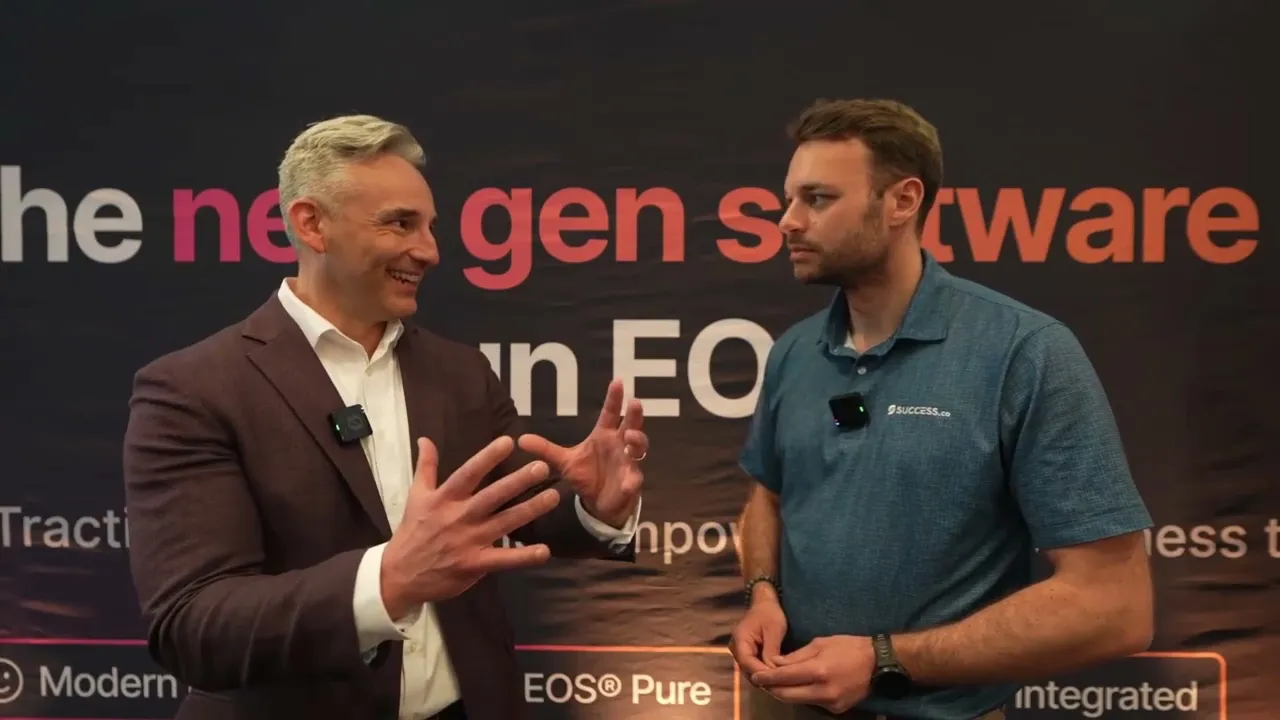
During the EOS Worldwide Conference in Kansas City, we were thrilled to have Mark O’Donnell (Visionary and CEO of EOS Worldwide) stop by our booth. We kept the camera rolling as he and Philipp Maucher chatted about the elephant in the room: How should companies running on EOS actually handle AI?
Mark’s take was a wake-up call for leadership teams: Stop thinking about tools. Start thinking about frameworks.
Over the last 12 months, the tech space hasn't just moved; it’s exploded. But Mark’s advice is a splash of cold water for those trying to "bolt-on" AI to their existing processes: you can't just hope it works.
You can't just say, ‘Hey, we’re going to use AI this way or that way,’ or ‘We’re going to use it to replace a human here or there’ because it’s moving too fast," Mark explains. "It is an exponential curve.
The good news? Humans have been here before, from the steam engine to the sundial. The tech changes, but the pattern of adoption stays the same. Here’s the "booth-side" breakdown of how to think about AI within EOS:
1. Always invite AI to the party
If you are executing a Rock or if you're solving an Issue, you always want to add AI to the party," Mark says. "You're always going to bring the latest and greatest technology to help you think through those issues.
It’s a powerful way to look at it because this isn't just abstract advice for the future; it’s actually happening right now with EOS teams who are using these tools to stop writing those "fluffy" goals that usually haunt quarterly planning sessions.
We’ve all seen it: someone suggests a Rock like "improve customer service," which sounds nice but means almost nothing. So, they use AI to push the thinking further until it becomes something SMART, like: "Implement a customer survey system with a 90% response rate by the end of Q3."
The same logic applies when you’re in a Level 10 Meeting trying to run IDS on a recurring issue that won’t stay solved.
Take those nagging shipping delays that keep popping up: while your gut might tell you it’s an inventory glitch because that’s what's visible on the surface, AI can actually cut through the noise to surface the real root cause.
But as great as that is, we have to stay grounded in what Mark calls the "jagged frontier" of AI. He put it perfectly: "It's very terrible at things that you think it should be good at. And then you're like, wow, it's better. And so it changes all the time."
Because that line is moving every single day, your job isn't to decide once and for all what AI can or can't do for your company.
Instead, you just have to keep testing the boundaries by throwing your next Rock draft at it, or using it to flesh out a Process that feels a bit too vague. Just dive in, see what actually moves the needle, and ignore the rest.
2. Be the human in the loop
We have pattern recognition. We know what great looks like," Mark explains. This is where AI becomes a 10x multiplier instead of just another tool.
AI doesn't replace judgment, it amplifies it.
Imagine AI suggests three Rocks for your next quarter based on your Scorecard trends and open Issues. While that’s a great head start, it’s still just a draft until you bring the actual context.
You’re the one who knows your V/TO priorities and the fact that you’re mid-transition to a new market, or that the leadership team specifically agreed to prioritize retention over acquisition this year.
You give it the direction it can’t find in the data.
It exposes individuals who don't fully get or have the capacity to do their job really well because they become sort of these slop cannons. They don't have clear thinking, they're not GWC, and they're multiplied by AI.
But flip that around: "People who truly are the right person in the right seat, with AI, it's a 10x, a 100x experience."
If you already know what a great Rock looks like, you’re just going to get there faster, and if you truly understand your sales process, you’re going to use AI to document it in a fraction of the time it used to take.
At the end of the day, the difference isn't the tech, it’s the human steering it.
It’s like a high-performance car: if you put someone who can’t drive behind the wheel, you’re going to get chaos, but put a skilled driver in that same seat and you get speed, precision, and total control.
Your job is to bring the clarity, while AI provides the horsepower.
3. Think of AI as an Accountability Chart seat
You've got to think of it sort of like an alien person. You got to think of it as an Accountability Chart seat.
It sounds wild, but it’s the only way to get past the vague "productivity boost" trap that most teams fall into.
If you were hiring a new person, you’d have clear expectations and measurables for them, so why treat AI any differently?
When you actually give it a seat on the chart, you stop treating the tech like magic and start treating it like a role you can manage. It means assigning real ownership over who is responsible for reviewing the output and setting a hard rule that while AI drafts, humans always approve.
By building that kind of accountability into the process, you can finally track the reality of the situation, like whether AI is actually helping you ship faster or if it’s just slowing the team down with extra noise.
Framing it this way also forces a much deeper level of honesty about where this all fits into your V/TO. You have to ask yourself: is AI a Core Focus accelerator that changes your DNA, is it an enabler for your Three-Year Picture, or is it just a tactical play to save a few hours a week?
Once you figure out that answer, the way you deploy it (and who you hold accountable for it) changes completely.
4. The AI you're using today is the worst AI you'll ever use
It's just going to get better and better over time," Mark points out. This isn't a reason to wait, it's a reason to start now.
When you look at the fact that 91% of SMBs using AI are already reporting revenue increases, it’s clear that the businesses jumping in today are building a massive learning advantage over everyone else who's sitting on the sidelines.
But even beyond the numbers, it’s about learning the framework today so you’re ready for tomorrow. After all, the AI that helps you sharpen a Rock this quarter is only going to be smarter by the next one. The tool spotting basic patterns in your Scorecard today will be catching much subtler signals by next year.
Mark brings up a historical example: "The earliest complaint I ever saw that technology was going to ruin our life, it was 600 BC. You know what the invention was? It was the sundial."
But we adopted that technology anyway, and today we have everything from wristwatches to atomic time because we realized that leveraging technology is how we amplify human productivity.
As Mark put it before heading back into the conference crowd: "I think AI automation in the context of EOS, truly, it's the same thing."


