- A Rock is your most important priority for the next 90 days, bigger than a to-do, smaller than an annual goal, and the way a 1-year plan becomes real.
- Strong Rocks are written SMART: specific, measurable, achievable, relevant, and completable inside the quarter. No partial credit.
- Fewer Rocks beat more: 3 to 7 for leadership, 1 to 3 for everyone else, each with exactly one owner, never a duo or a department.
- Rocks die for four reasons: too vague to complete, no real owner, nobody checks between quarterlies, or priorities shift mid-quarter.
- A weekly on track / off track status is what catches a stalled Rock in week four instead of at the next quarterly.
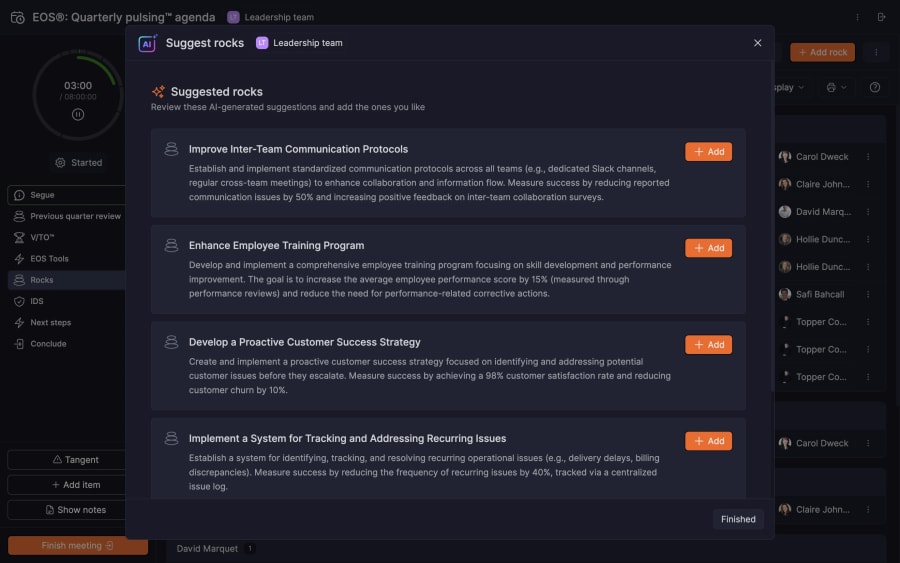
- Tracking Rocks inside Success.co keeps them visible all quarter, built into the L10™ agenda, with Ask AI to sharpen a vague Rock into a measurable one.
- Real examples by department (sales, operations, finance, HR) show the pattern: a number or a shipped thing, one finish line, sized for 90 days.
Every leadership team has met both kinds of key priorities: the kind that gets written on a whiteboard at the quarterly, and quietly abandoned somewhere around week six, and the kind that actually changes what the company looks like ninety days later.
What separates them is rarely effort or commitment, because teams generally work just as hard on the Rocks they fail as on the ones they finish.
The difference almost always traces back to how the Rock was set and written in the first place. A vague Rock cannot be completed, since nobody can say what complete would even mean. A Rock without a single owner belongs to everyone, which in practice means it belongs to no one. A Rock that nobody looks at between two quarterly meetings was never really a priority at all, just a wish with a date attached to it.
This guide is about writing the second kind: what a Rock actually is, the three criteria that separate a strong one from a vague one, the right number to carry per person, the four reasons Rocks die, and real examples by department that you are welcome to steal.
What is an EOS Rock?
A Rock is the most important priority that must get done in the next 90 days. Rocks are not everything that matters this quarter, only the few things that matter most.
The name comes from the well-known analogy of filling a jar: if you pour in the sand and pebbles first, the big rocks never fit. Put the big rocks in first and everything else settles around them. Your quarter works the same way: if the biggest priorities are not placed first and protected, the daily sand fills every available hour.
A Rock is also easy to confuse with two neighbors: the annual goal above it, the to-do below it.
Annual goals live in the 1-year plan of your Vision/Traction Organizer (V/TO), and they are too big to finish in a quarter. Rocks are how an annual goal becomes real: quarterly-sized pieces, each one completable in 90 days. If the 1-year plan says "launch in the UK market," this quarter's Rock might be "sign the first three UK reseller agreements." One is a direction, the other is a deliverable.
A to-do sits at the other end of the scale: it takes a week or two. A Rock lives in between, bigger than a to-do and smaller than a goal. Meaningful enough to move the year forward, small enough to finish by the Quarterly.
The 5 criteria of a strong Rock
Rocks are written SMART: Specific, Measurable, Achievable, Relevant, Time-bound. A Rock either meets all five or it will drift. There is no partial credit.
1. Specific
The Rock names a concrete outcome, not a theme. "Improve our onboarding" is a theme: anyone can claim progress on it and nobody can finish it. "New customer onboarding redesigned and live, with time-to-first-L10 under 7 days" is specific: you know exactly what exists at the end that does not exist today.
2. Measurable
At the end of the quarter, a Rock has to survive a simple verdict: done or not done. For that verdict to be possible, the Rock needs to end in something you can point at: a number reached, a thing shipped, a contract signed.
Compare "make progress on the new pricing model" with "new pricing model approved by the leadership team and live on the website." The first can never be finished, because progress has no finish line. The second ends the debate before it starts: either the page is live or it is not.
3. Achievable
A Rock stretches the team without breaking it. If it depends on hires that have not happened, budget that is not approved, or three other Rocks landing first, it is not achievable this quarter, it is a wish. Set Rocks you can own with the people and resources you actually have right now.
4. Relevant
A Rock has to move the company toward its quarterly priorities, not just keep someone busy. Before it goes on the list, it should answer one question: if we nail this in 90 days, does it clearly advance where the business is trying to go? If the honest answer is "not really," it is a task, not a Rock.
5. Time-bound (completable in 90 days)
A Rock that cannot realistically be finished by the quarterly is an annual goal wearing a Rock costume. It will be "on track" for two quarterlies and quietly rolled over at the third, and every rollover teaches your team that Rocks are negotiable.
If the outcome is too big for 90 days, cut it into the slice that is not. "Implement the new ERP" is not a Rock for most companies, but "ERP vendor selected and contract signed" is. Next quarter takes the next slice.
How many Rocks per person?
EOS says three to seven Rocks for people on the Leadership team, 1-3 Rocks for people outside of the Leadership team. But in practice the quarters that actually deliver tend to be the ones where everyone takes on less than more.
The reason is arithmetic more than willpower: Rocks come on top of everyone's day job rather than replacing it.
A leader who signs up for seven might be quietly admitting that two or three of them will not happen, and that they simply have not chosen which ones yet. The leader who commits to three has had that uncomfortable conversation before the quarter started, instead of discovering the answer in week eleven when it is too late to matter.
That narrowing is supposed to hurt, because the value of the exercise lives in the choice itself. Asking "what would be good to do this quarter?" produces a wish list that any leadership team could extend for hours, whereas asking "if only three things get done in the next ninety days, which three move the 1-year plan the most?" produces meaningful Rocks. Whatever does not survive that question is not lost; it goes to the Issues list, where it waits for a quarter that has room for it instead of quietly diluting this one.
One rule holds no matter how many Rocks you settle on: each one carries exactly one name, not a department and not a duo. A Rock shared between two people fails the way a shared seat does, with each person quietly certain that the other one had it.
4 reasons Rocks don't get completed
1. The Rock was too vague to complete
The most common failure happens before the quarter even starts. A Rock like "improve company culture" cannot be completed because completion was never defined. The fix is upstream: apply the SMART criteria at the quarterly, when the Rock is being written, not at week ten when it is already drifting. If the leadership team cannot state what "done" looks like in one sentence, the Rock is not ready to leave the room.
2. Nobody actually owned it
A Rock assigned to "the sales team" belongs to no one. When check-in time comes, everyone looks at everyone else: the owner does not have to do all the work, but they answer for the outcome, and they are the single person who says "on track" or "off track" each week and means it.
3. Nobody looked at it between quarterlies
The most painful version of this failure happens at the quarterly itself: a Rock everyone assumed was moving turns out to have stalled in week three, and nobody knew because nobody asked.
The weekly L10 closes that gap: every Rock gets a one-word status each week, on track or off track. A Rock cannot drift for three months when its owner says "off track" out loud in week four. That word is not a confession, it is an early warning, and it moves the Rock onto the issues list while there is still time for the team to help.
4. Priorities shifted mid-quarter
Something urgent lands in week five, and the Rocks written at the quarterly are quietly orphaned. EOS is deliberately strict here: the middle of the quarter is not the moment to renegotiate priorities. When something big comes up, it goes on the issues list and gets discussed at the L10 or the next Quarterly.
If Rocks get displaced every quarter anyway, the problem is not the Rocks. It is that the leadership team is confusing urgent with important, and the conversation about what actually matters needs to be more honest.
Tracking your Rocks inside Success.co

The weekly status check only works if the Rocks are where everyone can see them. A Rock list living in a slide from the last quarterly is invisible by week three.
In Success.co, every Rock carries a live On Track / Off Track status, and your Rocks are built into the L10 agenda, so the weekly review happens where the meeting already lives instead of in a separate document someone has to remember to open. Everyone sees the same list, the same owners and the same statuses, all quarter long. When a Rock goes off track, it is visible the week it happens, not the month after.
The Ask AI functionality within Success.co helps here too. A vague Rock like "improve marketing" is hard to track and easy to argue about at quarter end. Ask AI takes a rough goal and helps you sharpen it into something specific and measurable, with a clear owner and a number to hit by day 90. That is the difference between a Rock you can check on a Monday and one you keep redefining all quarter.
Rock examples by department
To make the criteria concrete, here is what strong Rocks look like across four departments, each specific, measurable and sized for 90 days:
Sales
- "12 qualified demos booked per month by end of quarter, up from 7"
- "New outbound sequence live and first 200 prospects contacted"
Operations
- "Average project delivery time reduced from 6 weeks to 4, measured over the last month of the quarter"
- "Quality checklist implemented and in use on 100% of client deliveries"
Finance
- "Monthly close completed within 5 business days, three months running"
- "2026 budget built, reviewed and approved by the leadership team"
HR / People
- "Two account executives hired and started"
- "90-day onboarding program documented and run with the next new hire"
Notice what every one of these has: a number or a shipped thing, one clear finish line, and a size that fits inside a quarter.
That is the whole discipline: write Rocks that can only be done or not done, give each one a single owner, look at them every week, and the quarter starts working for you.