- An org chart and an Accountability Chart can look identical, but one maps hierarchy and the other maps who owns what result.
- A traditional org chart shifts with every hire, exit, or promotion, and says nothing about the outcomes each person is on the hook to deliver.
- The EOS Accountability Chart starts from the functions the business actually needs, then places one accountable owner in each seat.
- One seat, one owner is the rule that changes everything, because if two people own a result, no one really does.
- The real value isn't the finished chart, it's the honest conversation that forces a team to agree, on the record, who owns what.
Whereas a traditional organizational chart merely maps reporting lines to illustrate hierarchy, an EOS Accountability Chart shifts the focus entirely toward defining who is singularly responsible for specific outcomes.
That distinction might initially sound subtle, but it marks the exact boundary between a business that merely projects the appearance of structure and one that actually operates with discipline.
Most leadership teams keep a standard org chart on file, yet remarkably few maintain absolute clarity on who owns each result. Consequently, when a critical task falls through the cracks, asking who was responsible usually yields several conflicting answers or an uncomfortable silence.
The Accountability Chart eliminates that confusion entirely, serving as the ultimate argument for any skeptic on your team who dismisses the framework as a superficial box-drawing exercise.
The traditional org chart, and where it falls short
An org chart does one job well: it maps the chain of command. Titles, departments, and reporting lines, all visible at a glance. For a new hire working out who signs off on what, that's genuinely useful, and worth keeping.
The trouble starts when you ask it to carry more weight than that.
Because it's built around people and their titles, an org chart is really a snapshot of who you employ today. It shifts every time someone joins, leaves, or gets promoted, and it tends to expand with your headcount rather than your strategy. What you're left with is a map of the team you have, not the structure the business needs to hit its long-term ambition.
It's also silent on the thing that matters most: results. A box labelled "VP of Operations" tells you where someone ranks. It doesn't tell you what they're on the hook to deliver, or how you'd know if it wasn't getting done. Two companies can run the exact same org chart and land wildly different outcomes, because the chart never described the outcomes in the first place.
And by putting hierarchy front and centre, it quietly suggests that seniority equals ownership. The most senior person in the room becomes the default owner of every problem, which is how leadership teams end up buried while everyone else waits to be told what to do.
The EOS Accountability Chart, and the thinking behind it
The Accountability Chart starts from a different question. Not who you have and where they sit, but what the business itself needs to run and grow, independent of the people currently in the building. You map those functions first, give each one a single accountable owner, and only then work out who fills them.
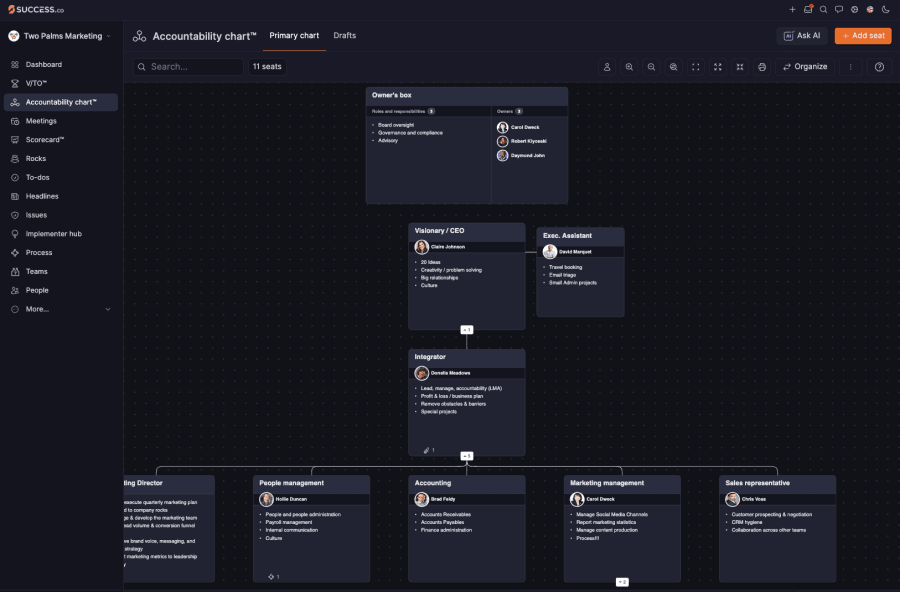
Structure before people
You start by designing the right structure for where the company is heading over the next 6 to 12 months, based on the functions the business needs rather than the people you happen to have today. Only once that structure is right do you place names in the seats.
That order matters, because it stops you bending the company around personalities and forces you to see the roles you're missing. And since the business never stops moving, the structure isn't fixed either: you revisit the chart each quarter and update it as you grow, so it stays a living tool rather than a diagram you drew once and filed away.
Seats, not job titles
Each box on the chart is a seat with a clear purpose and a handful of roles it owns, usually around five. A seat is really a set of accountabilities that a person then fills, and one person can sit in more than one seat, especially early on, which is fine as long as every seat has a single name against it. That last point is the rule that changes everything: one seat, one owner, because if two people are accountable for the same result, no one really is.
Gets it, Wants it, and has the Capacity to do it (GWC™)
Once the seats are clear, you can ask a much sharper question about your people than any org chart allows. Does this person Get it, Want it, and have the Capacity to do it? In other words, do they truly understand the role, genuinely want it, and have the time and talent to do it well?
All three have to be a yes, and that is what GWC gives you: a reliable way to tell the difference between someone who simply holds the title and someone who is right for the seat.
Org chart vs. Accountability Chart, side by side
Same boxes on the page, very different logic underneath. Here's where the two part ways.
- Built around. The org chart is organised by people and titles. The Accountability Chart is organised by functions and the outcomes each seat owns.
- The question it answers. The org chart answers "who reports to whom." The Accountability Chart answers "who owns what result."
- Where it starts. The org chart starts from the headcount you already have. The Accountability Chart starts from the structure the business actually needs.
- How often it changes. The org chart shifts with every hire, exit, or promotion. The Accountability Chart is reviewed quarterly and reshaped only when the structure genuinely changes.
- Link to performance. The org chart says nothing about results, because rank is not a result. On the Accountability Chart, every seat comes with owned outcomes.
- What it reveals. The org chart shows your reporting lines. The Accountability Chart surfaces what usually stays hidden: missing seats, roles owned by two people, and talented people sitting in the wrong seat.
But isn't this just redrawing the same boxes?
It's a fair challenge, and if the exercise ended with a tidier diagram, the sceptics would have a point. They don't, because the value was never the finished chart on the wall. It's the argument the leadership team has to finish before they can draw it.
Putting a single name against every seat forces a conversation most teams have quietly avoided: who actually owns this result, and are we willing to say so out loud. That's uncomfortable, and it's the entire point. The disagreements that surface in that hour were already costing the business, just invisibly, and the chart is what makes them impossible to keep ignoring.
So the sceptic is half right. Drawn carelessly, it really is only boxes. Drawn honestly, it's the first time the team has agreed, on the record, who is accountable for what. That agreement is the thing that changes how the company runs, long after anyone has looked at the diagram.
Ready to draw yours? Our Accountability Chart examples show what a finished one looks like, seat by seat.
Build your Accountability Chart inside Success.co
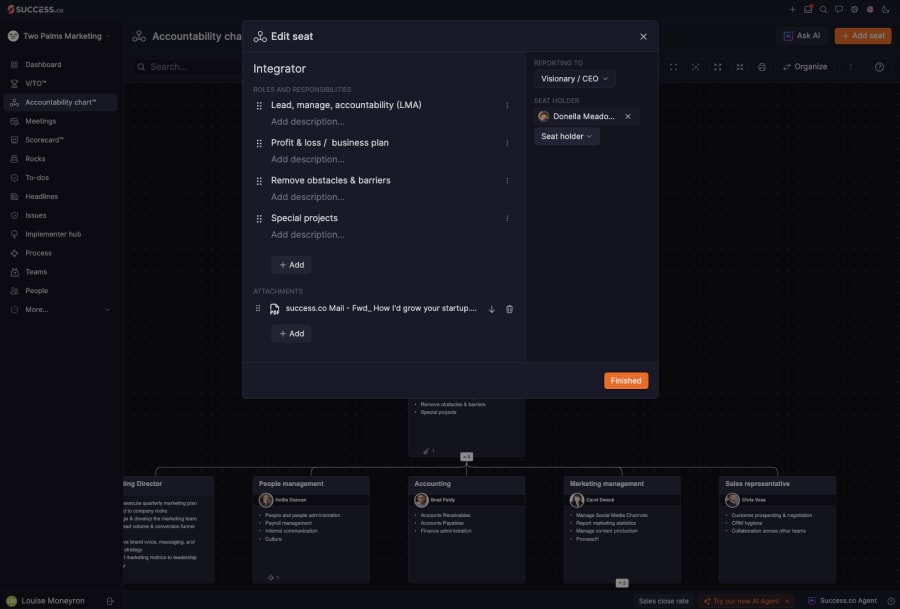
Drawing an Accountability Chart on a whiteboard is a good start. Keeping it live is where most teams come unstuck, because the moment it lives in a slide deck, it goes stale.
Success.co keeps that clarity live and visible across the whole company. The leadership team builds the chart in minutes, adding each seat, giving it an owner, and spelling out the roles and responsibilities beneath it.
It also stays connected to the actual work: you can raise an issue or create a to-do straight from a seat, add the chart to your Focus Day™ and planning meetings, download it as a PDF and print it for a no-screen session. And when the structure needs to change, you can build multiple drafts to plan for different scenarios, then convert one to the primary chart whenever it's ready for the whole company to see.
As an EOS® Official Licensee, Success.co follows the model the way it's meant to be run, not a loose approximation of it.
If your team has never had a single, agreed answer to "who owns this," this is where you give them one.
The bottom line
An org chart and an Accountability Chart can look almost identical on the page. Boxes, names, lines. The difference is what each one is really about: hierarchy, or accountability. Who ranks where, or who owns what.
For most leadership teams, that second question is the one quietly keeping them up at night. Answer it clearly, keep the answer live, and a surprising number of "people problems" turn out to have been structure problems all along.
That's why the difference matters. And it's a good place to start.